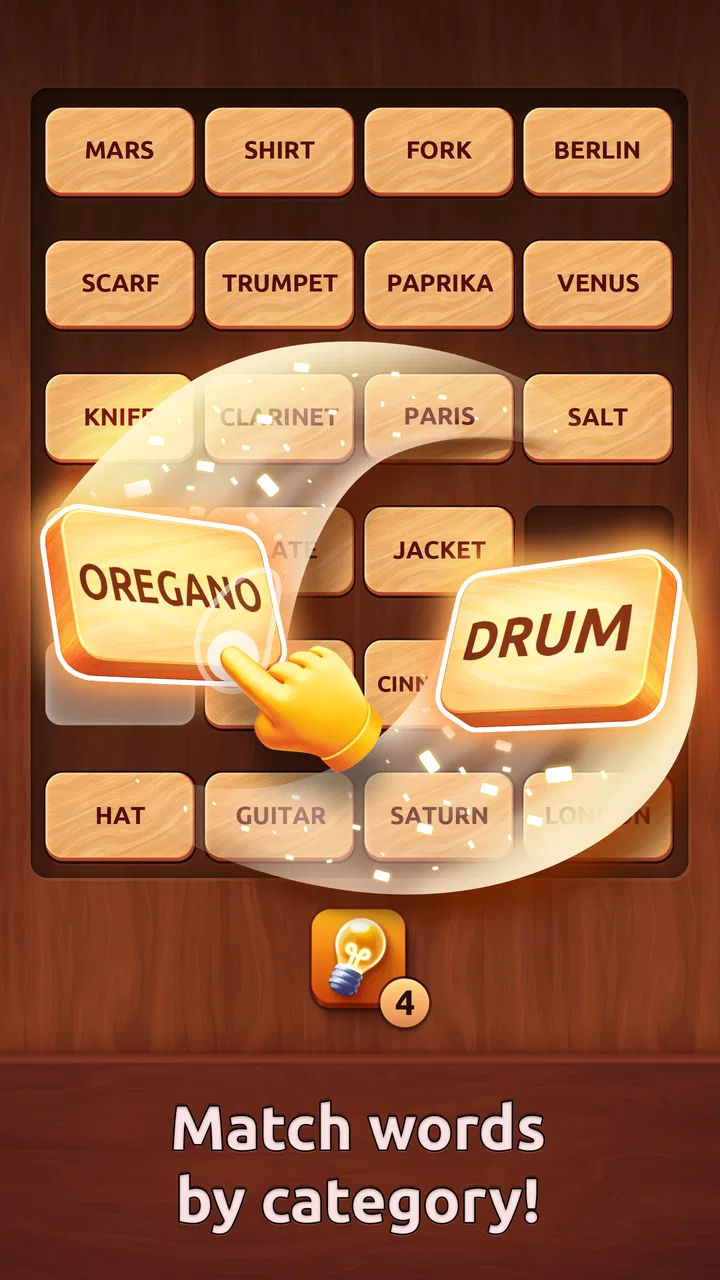
Associations - Colorwood Game
- 4.6
- Rating
- 5.00M
- Installs
- Free
- Price

 Analysis by App-foxy
I usually know within the first few sessions whether a word game is going to become part of my routine or disappear from my phone. Associations - Colorwood Game made a good early impression because it turns word knowledge into a calm sorting exercise rather than a race. The basic idea is easy to understand: I look at a group of words, search for relationships between them, and place them into categories. That simplicity makes it approachable, but the interesting part is how quickly familiar words can become uncertain when several possible connections compete for attention.
Developed by Burny Games, this is a free word game for Android, aimed at everyone and available on devices running Android 7.0 or later. Its store summary presents it as a relaxing association puzzle, and that description matches the mood I got while playing. It is not built around fast reflexes, complicated controls, or a large story. The appeal comes from noticing patterns, testing a theory, and enjoying the small satisfaction of finding the intended grouping.
After spending time with it, my view is fairly clear: this is strongest as a short daily mental break, not as a game I would play continuously for hours. It has enough mental variety to support a habit, although the long-term experience depends heavily on how much repetition you can tolerate in the same core format.
You May Also Like

 Pandora - Music & Podcasts
Pandora’s Music Is Easy to Start, but Harder to Recover
Pandora’s strength is its low-effort path from a seed to a station. Its weak spot is how much confidence it asks you to place in connection, setup, and quiet recovery.

 8 Ball Pool
 Is Built on Rivalries, Rematches, and Routine
A close look at the rivalries, rematches, shared routines, and unanswered safety questions that turn a quick pool match into a persistent mobile community.

 Samsung Music
’s Quiet Strength Is Playing What You Already Own
Its reach comes less from spectacle than from dependable access to a personal library. That simplicity is both the app’s strongest retention engine and its ceiling.

 AccuWeather: Weather Radar
AccuWeather Review: A Quick, Clear Forecast for Everyday Decisions
For everyday plans, the best forecast is the one you can understand quickly. AccuWeather makes rain timing, radar, and local conditions easy to act on, with a few trade-offs.

 Hill Climb Racing
Why Hill Climb Racing Still Turns Crashes Into One More Run
A tiny car, a bumpy hill and one more upgrade: Hill Climb Racing keeps resurfacing because its simple chaos makes every near-miss feel personal.

 AliExpress - Shopping App
AliExpress Makes Global Shopping Feel Personal, but Shoppers Bear the Risk
AliExpress turns a global marketplace into a pocket-sized discovery engine. Its reach is useful, its shopping loop compelling, and its trade-offs easy to miss.
More From Our News Desk
View All News


Why the first week feels so inviting
The opening experience is friendly because the rules do not need much explanation. I can start thinking about meanings immediately instead of learning a complicated interface. A word may belong with others because of its subject, use, wording, or a less obvious association. That creates a useful balance: the controls stay simple while the answers can still demand careful thought.
What I liked most during the first week was the change in difficulty from one puzzle to the next. Some groups feel almost obvious, which gives the session a smooth beginning. Others make me pause because one word seems to fit several categories. That second type is where the game earns its place. It asks me to stop accepting the first plausible answer and examine the whole collection before committing.
This is also why the game works well in small gaps during the day. I can play while waiting for an appointment, during a quiet coffee break, or when I want something more active than scrolling but less demanding than a full game. The relaxed format does not require a long uninterrupted session. If I leave after solving a puzzle, I do not feel that I have abandoned a complicated campaign or lost progress in a larger system.
A useful approach is to begin with the most concrete relationships rather than forcing a solution for every word at once. I first look for words that clearly share a topic or function, then remove them mentally from the remaining puzzle. This reduces the number of possible connections and often exposes the intended group. It is a small change in solving style, but it prevents me from becoming attached to a clever-looking category that does not explain the entire set.
The game is particularly suitable for people who enjoy language but do not necessarily want a traditional crossword. Crosswords often depend on clues, spelling, and crossing letters. A word search rewards visual scanning. Associations is more about classification and flexible thinking. I found it closer to organizing ideas in my head than filling in a grid, which gives it a different kind of satisfaction.
That difference matters when choosing it for someone else. If a friend likes finding hidden relationships between words, this is easy to recommend. If they prefer an exact answer supported by letters already on the board, the looser association style may feel frustrating. The game can be relaxing, but it is not always gentle in the mental sense; an ambiguous group can be surprisingly stubborn.
Small solving habits that make a real difference
My most effective habit was to treat suspicious words as temporary possibilities rather than firm answers. When three words seem to fit, I do not immediately decide that the fourth must be something similar. I ask what the fourth word contributes to the same category and whether the group would still feel natural if read aloud. This catches many attractive but incomplete connections.
I also found it helpful to separate literal links from cultural or language-based links. A group may look wrong if I expect every relationship to describe the same physical object or activity. Once I allow for broader word associations, some puzzles become clearer. The trade-off is that this flexibility can also make an answer feel subjective, especially when several categories appear defensible.
Another practical tip is to stop after a few unproductive attempts instead of repeatedly rearranging the same ideas. A short break often works better than stubbornness. Because the sessions are compact, coming back later does not feel like a major interruption. This is one of the game’s quiet strengths: it supports a pause-and-return style rather than demanding that I solve everything in one sitting.
By the end of the first week, I understood both sides of its appeal. The rules are accessible enough for casual players, yet the categories can make me reconsider words I thought I understood. At the same time, the game does not offer the broad variety of a large collection of unrelated puzzle types. The first-week freshness comes from learning how the associations behave, and that novelty naturally becomes less powerful with continued use.
What remains useful after the novelty fades
The more important question is whether the game can support a month-to-month habit. For me, its recurring value comes from the low effort required to begin. I do not need to prepare, remember a complex objective, or set aside a long block of time. When I want a quiet activity that still uses my attention, the word-grouping format is ready immediately.
That makes it a good companion to routines rather than a replacement for them. I can use a puzzle as a reset between work tasks, a way to settle down before bed, or a screen activity that feels more purposeful than browsing social feeds. In those situations, the game’s modest scope is an advantage. It gives me something to focus on without asking me to become deeply invested in a fictional world or competitive ranking.
Its category also gives it a mild learning benefit, although I would not treat it as a formal language course. The puzzles encourage me to notice shades of meaning, related concepts, and the way a word can operate in more than one context. That can sharpen vocabulary awareness, especially for players who enjoy thinking about why a group works. However, anyone looking for structured lessons, pronunciation practice, or systematic language progression should choose a dedicated learning app instead.
The game’s audience numbers suggest that it has reached a substantial player base: it has more than a million installs, an average rating of 4.6 from roughly 48 thousand ratings, and about 1.1 thousand written reviews. Those figures do not decide my opinion, but they fit my experience of a polished, approachable puzzle designed for broad appeal. The Everyone content rating also makes it easier to consider for shared household use, although individual enjoyment will still depend on vocabulary and tolerance for wordplay.
For a recurring habit, I recommend setting a natural stopping point. The game is more enjoyable when I play a few puzzles with full attention than when I keep going after my concentration has dropped. Since the central action is similar throughout, extended sessions can make the categories blur together. A short routine protects the relaxing quality and helps the game feel like a useful break instead of another task to finish.
There is also a social use case that I did not expect at first. A puzzle can work as a conversation starter when two people compare which words they grouped first and why. That is not the same as a built-in multiplayer experience, and I would not install it specifically as a party game. Still, the ambiguity of some associations gives people something to discuss, especially when one player sees a connection that another completely misses.
On the other hand, the game is less convincing for players who need constant escalation. If your ideal puzzle app adds new mechanics, competitive pressure, narrative chapters, or several distinct modes, this may feel narrow over time. Its value is in refining one idea, not in continually changing its identity. I see that as a deliberate strength for casual play, but it is a genuine limitation for people who quickly exhaust familiar formats.
Where maintenance is easy and where it is not
The maintenance burden is low in the practical sense. It is free to start, and the current version is 1.8.16461. I do not have to manage a complicated profile or maintain a long-term strategy. The game can sit unused for a while and still be easy to pick up again, which suits anyone whose schedule changes from day to day.
The financial side deserves a closer look. Optional in-app purchases range from $2.99 to $99.99 per item. I would approach those purchases carefully and decide in advance whether the free experience already gives me enough value. A casual player who only wants occasional puzzles may have no reason to spend money, while someone who plays frequently should consider whether paid extras improve the experience enough to justify the cost.
That price range is also the main reason I would not recommend handing the phone to a child without checking purchase settings first. The game is rated for Everyone, which speaks to its content, but an age rating is not the same thing as a spending plan. For family use, I would make sure purchases require approval and explain that the game can be enjoyed without treating every obstacle as a reason to buy something.
From a habit perspective, the bigger maintenance issue is mental rather than technical. I need to keep my expectations realistic. This is not an app I expect to transform my vocabulary or provide endless novelty. I return because it is convenient, calm, and occasionally clever. When I judge it by those standards, it remains useful. When I expect a deep progression system, its narrow focus becomes more noticeable.
A simple rotation can help. I would keep this game for short word-focused sessions and alternate it with a crossword, a spelling puzzle, or a logic game when I want a different kind of challenge. That prevents the association format from becoming stale while preserving its role as the quick option. In my experience, the best long-term use is not exclusive loyalty but a small place in a varied puzzle routine.
What can cause fatigue over time
The first source of fatigue is repetition in the basic interaction. No matter how interesting the words are, I am still grouping them into categories. Players who enjoy mastering a single pattern may find that comforting. Players who need fresh controls or changing objectives may eventually feel that they are solving the same type of problem in different clothing.
The second issue is ambiguity. A challenging association puzzle can be satisfying when the intended answer becomes clear after careful thought. It can be less satisfying when I understand several possible groupings and cannot tell which one the game expects. That uncertainty is part of the design, but it can feel like a weakness if the relationship depends on a narrow interpretation rather than a strong shared meaning.
I also noticed that the relaxing presentation can create a mismatch with the actual effort required. The game looks and feels suitable for unwinding, yet some puzzles still demand sustained concentration. That is not a contradiction, but it is worth knowing before choosing it as a completely passive bedtime activity. If I am already tired, a difficult category can feel more irritating than calming.
Another trade-off concerns vocabulary range. A player with broad familiarity across subjects may have an advantage, while someone encountering unfamiliar terms can struggle for reasons unrelated to reasoning skill. The Everyone rating makes the game broadly accessible in terms of content, but it does not guarantee that every puzzle will feel equally approachable to every age or reading level.
Hints, retries, or other assistance can change how satisfying a puzzle feels, depending on how they are presented and whether the player relies on them. My advice is to pause before using help. First remove the words that have only one convincing home, then reconsider the leftovers from a different angle. This keeps the solving process active and reduces the temptation to turn every difficult moment into a purchase or an immediate shortcut.
The game is also not the right choice for someone seeking a competitive word experience. I would choose a timed word battle or a leaderboard-driven title for direct pressure against other players. I would choose a crossword for a more structured deduction path. I would choose a language-learning tool for measurable study. Associations sits between these options: more reflective than competitive, more conceptual than letter-based, and more casual than educational.
That comparison helps explain its lasting appeal. It does not need to beat every alternative. It only needs to be the right answer when I want a compact association challenge with a calm tone. Its weakness appears when I ask it to serve a different purpose. Many negative reactions to this kind of game come from expecting depth, instruction, or variety that its focused design was never intended to provide.
My long-term verdict for everyday players
After the novelty fades, I still see a place for this game, but I would keep that place modest. It earns recurring use because it starts quickly, works in short sessions, and gives ordinary words enough tension to become puzzles. The experience is especially good for a person who likes quiet concentration and wants a break that feels mentally active without becoming competitive.
I would recommend it to a friend who enjoys word categories, casual brain training, or discussing why two ideas belong together. I would also recommend it to someone who wants a low-commitment game for commuting, waiting rooms, or a short evening reset. The free entry point makes it easy to test whether the central format suits you before considering any optional purchase.
I would skip it for a friend who becomes bored by repeated mechanics, dislikes subjective answers, or wants a clear sense of progression. I would also suggest another option for anyone searching for a serious vocabulary curriculum, a multiplayer contest, or a puzzle collection with constant mechanical surprises. This game’s identity is narrower, and that narrowness should be treated as a choice rather than overlooked.
Burny Games has made a word game that understands the value of restraint. Its best moments come from a small mental shift: a word that seemed misplaced suddenly makes sense, and the whole group falls into place. Its weakest moments come when the same restrained structure starts to feel predictable or when an association is not convincing enough to overcome the puzzle’s ambiguity.
My final recommendation is to treat it as a dependable pocket-sized habit, not an endless main event. Play it when you want a calm challenge, stop before the format becomes tiring, and keep a different puzzle style available for variety. Used that way, Associations - Colorwood Game has enough recurring value to remain installed after the first-week curiosity disappears.
FAQs for Associations - Colorwood Game
01What is the primary objective of Associations - Colorwood Game?
Associations - Colorwood Game is a puzzle and brain training app designed to stimulate cognitive function by challenging players to make associations and connections between various elements. The goal is to enhance memory, improve problem-solving skills, and promote out-of-the-box thinking while providing an engaging and entertaining experience.
02Is Associations - Colorwood Game suitable for all age groups?
Yes, Associations - Colorwood Game is designed to be accessible and enjoyable for players of all ages. The complexity and difficulty of the puzzles can appeal to both children and adults, making it an excellent choice for family fun or individual cognitive training. Its user-friendly interface ensures easy navigation for younger players.
03Does Associations - Colorwood Game require an internet connection to play?
Associations - Colorwood Game can be played offline, making it perfect for on-the-go entertainment without the need for a constant internet connection. However, some features, such as leaderboards or updates, might require internet access to fully enjoy all aspects of the game.
04What platforms is Associations - Colorwood Game available on?
Associations - Colorwood Game is available on both Android and iOS platforms. Users can download it directly from the Google Play Store for Android devices or the Apple App Store for iOS devices. It's optimized for smartphones and tablets, ensuring a smooth gaming experience across various devices.
05Are there in-app purchases in Associations - Colorwood Game?
While Associations - Colorwood Game is free to download and play, it may offer in-app purchases. These can include additional levels, hints, or customizations to enhance the gaming experience. Players should be aware of these optional purchases, especially if children are using the app.
Pros
- Beautiful
- vibrant graphics enhance gameplay.
- Simple mechanics suitable for all ages.
- Challenging levels keep players engaged.
- Regular updates with new content.
- Offline mode available for on-the-go play.
Cons
- In-app purchases can be costly.
- Ads may interrupt gameplay frequently.
- Limited lives can hinder progress.
- No multiplayer mode available.
- Some levels can be repetitive.

Associations - Colorwood Game
Gallery